Showing posts with label evolution. Show all posts

Thursday, February 4, 2010

Rotifers and the Pausing of Time

If you're like most people, you've never heard of rotifers (right). I'm not going to go and say these little creatures determine our way of life or anything, but a mystery about them has recently been solved. They've been examined ever since the microscope was invented, and have a couple interesting traits. For one, they have little spinning arms that propel food into their mouth – see the two furry things in the picture. For another, as reported on Science Friday, they don't have sex.

How do we know there never comes a point when two rotifers love each other very much? Well, not only has it never been observed, but also in 300 years of watching rotifers through microscopes, no one has ever even seen a male. There is additional modern genetic evidence that there are only female rotifers.

What's the big with not doing it? Well, the genetic exchange that occurs during meiosis greatly enhances variability of individuals within a species, speeding up evolution. Eliminate sex and a species basically freezes form.

Why is a static genome a problem? Everyone else is evolving, including your enemies. Say there's something in your blood that gives your species a resistance to certain parasite. Well, those parasites are having sex all the time, and eventually one might come about that happens to have a resistance to your blood. Since your species hasn't been having sex all this time, you have almost no genetic variation, and no one has any resistance, and you all die out and go extinct.

So that's why sex is good. There are even species of animals that under favorable circumstances skip the males and just have female offspring and basically clone themselves. However, once the environment turns sour, there starts being males born who then have sex with females, increasing variability, with the evolutionary "hope" that some new individuals will happen to have a greater tolerance to dry weather, or smaller size, or whatever. These species will skip sex for several generations, but eventually do it.

But bdelloid rotifers haven't done it in 35 million years. How do they get away with such genetic similarity? One possibility is that they don't have enemies. Oh, but they do. As researchers at Cornell University showed, certain species of fungus will decimate rotifer populations. As in, kill every single active rotifer.

What, you ask, is an inactive rotifer? Well, that's what the Cornell scientists figured out. Rotifers have the ability to dehydrate themselves, completely expunging any water from their body. They go into a state of suspended animation, essentially stopping time for anywhere from a few weeks to ten years. But when the rotifer comes back from its stasis field, won't the infecting fungus also reanimate?

Rotifers have extremely robust DNA that is good at reassembling itself after it gets broken when the rotifer dries out. The fungus does not have the same ability and the drying period kills it. The Cornell scientists even determined how much of the fungus was killed after 2, 3, 4, and 5 weeks, and found that a month was all the rotifer needed to purge the fungus from itself.

So rotifers can isolate themselves from the fungus in time. They can also do it in space. When they become dehydrated, they become little dandelion seeds (from an aerodynamics point of view anyway). That means that they are easily picked up by breezes and carried to a new, happy, fungus-free home.

One thing I didn't understand is that they program mentioned there are several hundred species of rotifers. But isn't sex and genetic variation the driving force behind evolution and speciation? Any thoughts?

Wednesday, January 27, 2010

Cane Toads

Cane toads, also known as Giant Neotropical Toad, are five-inch long creatures with poisonous skin glands, originally from Latin America. Until 1935, they were not found in Australia. That year, they were introduced to control a beetle infestation, and have themselves become a plague. You can see this all, in stunning clarity, in Cane Toads: The Conquest (in 3D!). In the documentary, they cover a variety of methods the Australians are trying to control the toads.

However, some people think that the toads are a resource. As covered in the Outback edition of Bizarre Foods, there are clubs that go out at night and cook frog legs, taking care not to put any poison in the food. A game meat processor is even hoping to export the frog legs to the Chinese.

The frogs are not only a possible source of food, but also of drugs. The venom can be extracted, dried, and then smoked. The frogs can also be simply licked, although the effect is not as pronounced. The cane toads are not alone in their ability to create "sense of wonder and well-being". Many poisonous amphibians, including several found in the US, can produce similar effects, and "a healthy toad can fetch up to $8" in California. However, one should be careful about entering this trade, as a proposed law in South Carolina would "sentence violators [of amphibian trafficking] to 60 hours of public service in a local zoo."

And interestingly, humans are not the only species to use toads as a drug. There is at least one story about a dog repeatedly licking frogs, and then wandering about, all "disoriented and withdrawn, soporific and glassy-eyed." The toads are incredibly tough, as evidenced by cane toad that was swallowed by a dog and hung out in its stomach for 40 minutes. It now lives in the animal hospital where the dog was taken and given an injection to vomit it up.

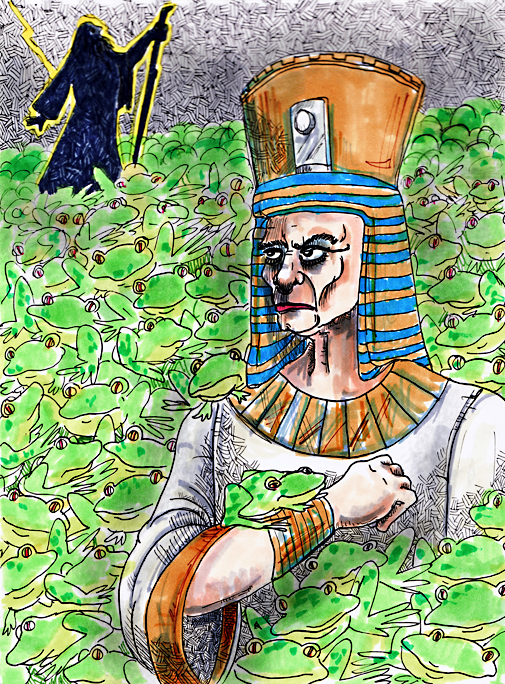
Indestructible, poisonous, and everywhere. Clearly the only way to get rid of the plague of frogs is to tell Moses that we'll let his people go.

Wednesday, October 28, 2009

Birth Control Pills Might Alter Mate Selection

Yahoo News runs a story about some studies which may indicate that the birth control pill influence women's choice of mate. Researchers at the University of Sheffield in England predict that "offspring of pill users are more homozygous than expected, possibly related to impaired immune function and decreased perceived health and attractiveness." The idea is that women who are ovulating tend to be attracted to Manly Men, but women on the pill are hormonally in a state similar to perpetual pregnancy. Therefore, the claim goes, that women on the pill will be less likely to date the captain of the football team, and instead hook up with president of the role-playing club. It is important to note that the "impaired immune function", et cetera, of the predicted offspring are not a result of the woman actually taking the pill, but because of the 'less reproductively sound' mate she chose because the pill clouded her judgment.

Not everyone agrees, however. Dr. William Hurd of Case Medical Center is skeptical:
If you don't take into account society maybe we're all animals, but in social situations I don't think there are many women who change who they would mate with at different times of the month. It might change desires or perceptions but, gee whiz, that's a long stretch to changing who you would date, or even who you would go to dinner with.
Also, I may be wrong here, but I would think that many women taking the pill are doing it because they are already in a relationship (and therefore have chosen their "mate").

Friday, October 23, 2009

Monkeys with Skills Earn More than Senior Monkeys

Physorg (among others) has a story about a test involving groups of vervet monkeys. The group was in a room with a barrel of apples that none of them knew how to open. None of them, that is except for one low ranking female who wasn't getting much attention or income. (What is monkey income you ask? Getting groomed by other monkeys.) However, once this skilled junior would open the barrel and hand out apples, she suddenly became much more popular (and groomed). This proves that in the monkey world as well, girls like guys (or girls) who have skills (although not in this case nunchuku skills, bow hunting skills, computer hacking skills).

But it gets really interesting when the researchers introduce a second skilled monkey to the group. Suddenly Barrel-cracker #1 no longer has a monopoly on the apple market. The invisible monkey hand reacts to the adjusted supply and demand, and the additional apple-getter drives down the 'price' of apples, so now each of the skilled monkeys gets groomed some intermediate amount: more than a normal junior-rank monkey but more than if they were the only barrel-opener in the bunch.

It's interesting that such price reduction takes place even without language, showing how ubiquitous basic economic theory is.
A change in price - grooming for less long if there is another monkey that supplies apples - is only possible if a negotiation process takes place. Many economists assume that such negotiations can only take place if they are concluded with a contract. However, the vervet monkeys do not have the possibility to conclude such binding contracts and yet they still succeed in agreeing to a change in price for a service.

Friday, October 2, 2009

Reverse Evolution?

The New York Times has an article questioning if evolution can run backwards.

The Belgian biologist Louis Dollo was the first scientist to ponder reverse evolution. “An organism never returns to its former state,” he declared in 1905, a statement later dubbed Dollo’s law.

To see if he was right, biologists have reconstructed evolutionary history. In 2003, for example, a team of scientists studied wings on stick insects. They found that the insects’ common ancestor had wings, but some of its descendants lost them. Later, some of those flightless insects evolved wings again.

Yet this study did not necessarily refute Dollo’s law. The stick insects may indeed have evolved a new set of wings, but it is not clear whether this change appeared as reverse evolution at the molecular level. Did the insects go back to the exact original biochemistry for building wings, or find a new route, essentially evolving new proteins?
What follows next is a fairly high-level summary of Dr Thornton's U of Oregon research on changing protein receptors. Basically, what he found was he could change forward "ancestral" proteins by altering a limited number of receptors. However, to change backward modern proteins, additional modifications needed to be made. He deduced that during evolution, in addition to specific changes to ancestral proteins that actually account their ability to do new things, there are also "silent" changes (that evolved by chance along with the significant changes) that don't actually affect the behavior of the modern ones. However, they do prevent the modern proteins from going back to the original function (unless they too are removed). Since the ancestral proteins can go forward with or without the silent changes, but the modern proteins only work in the ancestral form without the silent changes, reverse evolution is far less likely to occur.

In other words, if our kids start having tails, it's not because we are not going back to monkey-style tails, but rather whatever new configuration happens to be most beneficial to our survival. Sorry, Jonathan Coulton, but we're not De-Evolving.